Wednesday, May 8, 2013

Teaching Social Studies to Students with Disabilities


           In Chapter 10 of our text book it gives us teachers a list of instructional strategies for students with disabilities. I think this is so important because I feel that students with disabilities often get over looked in classrooms and that teachers don't always know the right techniques to help out those students who have disabilities.
The book talks about cooperative group activities. In this activity each member of the group has a specific assignment. This is helpful towards students with disabilities because there is no competition between students with disabilities and students without them. Cooperative learning is taking place because students are learning together and helping each other out versus competing to have the best grade or answer.
In the peer buddy system, students are buddied up with another student and help them through their struggles or problems, much like a counselor. This works out well because the student with the disability gets assistance and peer help rather than a teacher's assistance. The student may be buddied up with a student who has shared that disability such as an arm in a cast. The student will feel more confident working with someone who has gone through the same thing as him/her before.
Reciprocal teaching is when students are engaging in learning strategies to improve comprehension by questioning, summarizing, clarifying, and predicting. There are a variety of different resources students can use to work with this but the main goal is to improve comprehension. This is done in groups, and again benefits because of cooperative learning versus individual learning.


These are only three of a couple strategies that the book gives us, but I feel like these are very effective ones. From what I've learned about students with disabilities in my other classes are that you obviously want to make them feel no different than any of the students with out disabilities so what better way to help them then buddy them up with someone to help them?

Visuals


          Earlier on in the semester we had to find an article on how to teach geography. I'm a very visual learner and I feel that a lot of younger students are visual learners as well. If the student can see the action or see why something happens they are more likely to understand it then someone just telling them what will happen.
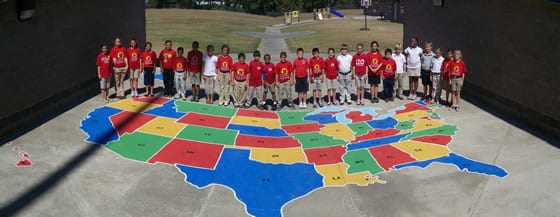
My article was about painting a map of the United States on the ground of playgrounds across the country to help students become interested in geography and improve their learning.


 I thought this was a great article because it's something simple but could have such a great impact. I remember after I left my elementary school, they painted a map of the US on the playground. I was actually kind of upset that they decided to do it after I left because I could've had so much fun with it. Not only can teachers walk their classes outside (almost as a....field trip) but students can also be interactive with it during recess time or during out of school time with friends. Teachers could play games with the states and students could play games on their own with the map. It is an easy, simple, small way to have such a big impact on students.


"Useful Instrctional Activites for the Lesson Development Phase"


As I continued to read Chapter 7 in our text book, I became really intrigued by the useful instructional activities for the lesson development phase.
Our text book listed the following:

Field Trips
 The one thing I loved LOVED about elementary school was all the field trips I went on. I think that field trips can be extremely educational and beneficial to students. What's a better way to get a child excited for learning than taking them out of their classroom and bringing them to a new location with tons of stimulation? Nothing.  Even small field trips are beneficial to students because sometimes it's nice to just be able to get out of the typical education environment.


 Guest Speakers
Having a guest speaker is second best to having a field trip. Although students don't normally get to go anywhere, it's a change to their normal day activity. Students will be eager to see what the new person coming into their classroom has to say to them.  This can also be beneficial because sometimes the speaker has gone through something that you're teaching the students. If the students can see and hear how someone lived through a time period they're learning about, they may be more willing to pay attention or even eager to go back and talk about the subject in social studies class. 


Demonstration
Not all, but many students are visual learners. Most of the time students learn and comprehend information better when it is presented in front of them in a visually stimulating way. Demonstrations are a great way to switch things up in the classroom and keep the students engaged and entertained enough to pay attention. 


 Lecture/Teacher Presentation
Even though it may not always be the most effective way, lecturing and teacher presentations can obviously help students with learning as well. Even young elementary students should be exposed to lecture style teaching, but for shorter periods of time. 

 
Games
If used properly games can be very educational and beneficial to students' learning. Everyone loves games, everyone likes to have fun! Every student needs their lesson changed up here and there, and games are a great way to switch things up while remaining educational.

"Matching Instructional Strategies to Student Needs"


          I was reading Chapter 7 in our text book Social Studies for the Elementary and Middle Grades and I was interested in what the difference is between the teaching strategies and how they benefit students in different ways.

       Direct Instruction
In direct instruction, the control is mostly in the teacher's hand. The teacher provides directions and motivation for the students, and opportunities for the students to practice their skills in different situations. The teacher also provides continuous feedback to students when they answer questions correctly. The main way to teach direct instruction is through lecture, and closed, narrow questions. 
Direct instruction requires external motivation, which students may lack, and classroom management is also key when teaching through the direct instruction. One of the main problems with direct instruction is that it produces lower levels of learning...recalling and memorizing. This makes sense because students have difficulty focusing and comprehending all the information the teacher is saying through lecture style. It really isn't easy to sit in a seat for an extended period time and listen to a teacher talk and talk all period; your mind is bound to wander and have difficulty focusing solely on what the teacher is saying.

       Guided Discovery 
In this teaching method, the teacher creates a problem, provides materials, and determines the procedures, but leaves the students to investigate, collect & analyze data, and evaluate results towards the problem. Students are provided with materials and time and use several activities to solve the problem. The students are the ones doing most of the work, while the teacher simply provides directions and asks questions to get students started and on the right path. 
Guided discovery differs from direct instruction because more control is placed on the students. Students are doing more things on their own and it is less sitting there and listening. Students are actively participating and researching a solution to the problem. Students also get to work together more during this method than in the direct instruction. This is a good method because  students get a little bit more responsibility and are being actively engaged in the lesson. Students have more responsibility and will learn how researching and analyzing data is key to solving a problem. 

       Inquiry&Problem Solving/Decision-Making 
This method is similar to guided discovery, however even more responsibility is placed on the students because they are creating their own problem versus having the teacher provide them with the problem. Students are also in charge of finding materials and figuring out the procedures necessary to solve the problem they have created. 
This method tends to motivating because students are doing basically everything on their own. They are creating their own problem, they're researching the information, they're figuring out the steps to solving the problem, and that's exciting for a student. I know, since I'm still a student, nothing feels greater than accomplishing something on your own instead of the teacher just telling you the answer.

These three methods are similar in some ways, but vary in a bunch of different ways. To me, personally, the inquiry&problem solving/decision making method sound the best to me. I'm a doer, I learn by doing things for myself, I don't learn well from sitting in a room and listening to a teacher lecture me for forty minutes. I lose focus, I get lost in the topic, my mind wanders, but if I'm doing things for myself, if I create the problem and the steps to solve it, I'm more likely to take more away from the experience than just sitting and listening to a lecture.   

Cooperative Learning


          For our last lesson, we taught using a cooperative teaching strategy. We started off the lesson by introducing nine terms to the students. These terms were definitely easier for the students to comprehend because chances are they already knew them. The terms were advertisement, campaign, demand, supply, slogan, logo, marketing, resource, scarcity. We were able to teach students that when supply goes up, so does demand, which may also cause scarcity because the product is in such high demand and that they lack resources to fill the supply. Students really seemed to comprehend the terms because they all seemed like they have heard them before.
Since today's lesson is on cooperative learning, we want students to understand what constructive criticism is since they will be working on a project together. We reviewed the definition for the students and then provided them with four examples and nonexamples of constructive criticism. We had students use the green and red cards to show us whether they thought the it was an example or a nonexample. This went pretty quickly which left a lot of time for the last thing we wanted to students to do.
           We came up with a "secret" project for the students to do with their groups. We provided students with definitions and a type of presentation; rap, poem, poster, and collage, and the students had to create it to present in front of the class. The point was for students to work together and show how much they know from the weeks that we've been teaching. after they presented, students got back into their groups and constructively criticized how they did. They received a worksheet paper to fill out to report their constructive criticism.

          I can see that cooperative learning is very different from direct instruction and inquiry but also why it is important. Students need to learn how to cooperate and learn with each other instead of just solely learning from a teacher. We were told once in class that student retain 95% of the information presented to them when it is taught from their peers and not from the teacher. If this is really true, then more lessons should be focused around students learning and teaching each other.

Inquiry Lesson Plan


            For our second lesson we taught using an inquiry/indirect lesson plan. We began today by reminding students of where we're at in the movie making process. We told students that they had about 5 minutes to put the finishing touches on their commercials and then we'd be performing them in front of the class. Luckily everyone was prepared well and the commercials.The commercials were so cute and adorable and made me so proud that the students were able to create them on their own and perform them in front of their classmates.
           Since this lesson is through inquiry steps, we reviewed the inquiry steps and showed students how they would use the inquiry steps to connect with their movies.
We gave each group a "Forecast Form" that they were to use to predict how much money their company would make off of their movie.
The estimations the students came up with were pretty reasonable and I know that made my cooperating teachers and me very excited that students were grasping the concepts that they were learning.
           Teaching through the inquiry steps was something I was definitely not used to. To be honest, I wasn't even really sure of the inquiry steps until my previous teachers had taught the students it. I don't think I've ever been taught through an inquiry process, or if I have, I have little to no recollection of it! It was definitely a little different and challenging at a point, but I can see why it's important. When we taught through direct instruction, we were teaching the students the whole time, lecturing them almost, while they sat there and took it all in. Sitting for a forty minute period listening to someone talk is a struggle for anyone, but even more of a struggle for young students who are doing their best to focus but simply can't. With the inquiry lesson plan it worked well because students had the chance to work together and work the problem out themselves without being told how to do it. This put more of the responsibility on the student, which is necessary. Students seemed to understand what was being asked of them during the inquiry process, were able to comprehend what was being taught, and each group was able to provide us with an answer to the question.

Direct Instruction Lesson Reflection


This blog is a couple weeks late as to the actual date when we performed our lesson, but I'm going to talk as if it had just happened today, because luckily I remember it just like it was yesterday!!

          Today was our first lesson, we taught the students about what makes up a good commercial using direct lesson instruction plan. We started off the lesson by having the students watch a thirty second commercial from the movie Monster's Inc. We asked students to watch the clip and then, using the commercial for help, we wanted them to tell us what THEY think makes up a good commercial. We were looking for students to say things such as: there's a narrator, they're are pop up actions that catch your attention by surprising you, there's music, they reveal the problem of the movie but not the solution, etc. The students were able to provide us with such answers, but they missed most of the terms that we were about to teach them, so it kind of worked out well still. 
          After the students gave us about eight examples we moved on with the lesson and introduced the terms that help define what a good commercial contains.
 We explained each term to the students and provided examples to them. After we did this we told students that they were going to rewatch the commercial they just previously watched. This time we wanted students to watch it with a keener eye because they knew what they'd be looking for. Once the commercial was over, we were able to relate the terms to the commercial and have students prove comprehension when they told us how each term was used in the commercial.
          Next we introduced students to other important terms when it comes to making a movie, terms that their businesses should keep in mind when creating their movies.

We provided the students with examples of each term. It was a struggle for us to think of terms for intellectual property, because our understanding of it was a little confusing. I thought that was interesting because when I was a young, naive, student I thought teachers knew everything and that they didn't really struggle with teaching us because the information was so easy to them, but this helped bring me back to reality. It's difficult teaching some subjects, because although we've learned it all before, we may not have had the best teacher teaching it or we may have not comprehended it as well as we should've. Luckily, Dr. Smirnova even helped us come up with an example for the students to understand it.
          Not going to lie, we kind of went through the terms very quickly because we needed to get onto the next part of our lesson; students creating their OWN movie commercials!! We explained to students that they'd be creating their own commercials today and that they had to include the following in their commercials.


 Students then broke off into their groups and worked on their commercials. We ended the lesson by informing students that in the next class they would be performing their commercials in front of the class! I'm excited to see how their commercials turn out because it seems that majority of students in the class, with an exception to a few, are really enjoying this project so far.


Sunday, May 5, 2013

My Personal Philosophy on Teaching Social Studies


                I’ve learned a lot of valuable information through my semester social studies method class. Going into the class I honestly thought social studies was mostly just history because that’s what I remembered it to be when I was in elementary school. I don’t remember learning economics or geography, I just remember the historical aspect of social studies, but with the help of this class I’ve learned that social studies is much more than just history. Social studies is about the study of human society and the different branches that are included in that. I learned through this class that there are ten themes of social studies that I didn’t know existed before. The themes are: culture; time, continuity, and change; people, places, and environment; individual development and identity; individuals, groups, and institutions; power, authority, and governance; production, distribution, and consumption; science, technology, and society; global connections; civic ideals and practices. I’ve learned that teaching social studies isn’t about just teaching the cookie cutter history information that students just memorize and regurgitate for a grade, it’s about much more.
                It is important to keep students actively engaged when teaching them about social studies. I’ve never been fond of social studies before because, quite frankly, I remember it as always being boring. What I remember about social studies was sitting in the classroom at our desks, textbooks out, reading the chapters and then answering questions. No engagement, barely any intriguing projects; nothing really captured my attention and made me remember it to this day, except for one project. While in fifth grade we did a grade wide project where each student received a state and had to do their own research on it; what the state capital was, what they were famous for, who lived there, what famous people lived there, etc. At the end of the school year, we would make a poster board and handouts for our classmates and parents and provide them with brief facts about the state. I remember this because I was actively engaged in this project, I was researching, cutting, gluing, typing, writing, reading; I wasn’t sitting in a desk reading a chapter and answering questions.
                That is how I want to teach social studies to my students, I want to engage them, I want them to be excited about learning instead of thinking it is a boring mundane process that they’re counting down the minutes until it’s over. I’ve definitely learned through this social studies methods class ways to engage students. Technology is an easy, reliable (most of the time), quick way to engage students and keep them engaged. Dr. Smirnova was constantly using technology with us while teaching us, making us engaged and active learners. Students also retrain more information through visuals than just through auditory. I plan on using different visuals to keep students actively engaged and participating in classroom activities.
                BizMovie was a great program that really helped students understands the basics of economics in a short time span. I think the program definitely will be something I’ll look into using potentially in my future. Students were usually always engaged and active in lessons because the program required them to be. Besides the direct teaching instruction, most of the lessons involved the students to participate and pay attention while learning. We were able to grab the students’ attention through our different presentation programs and through the tasks they were asked to do.
                I have learned all different types of techniques and strategies for teaching social studies in the future thanks to my social studies methods class. I know that I need to get my students’ attention and keep it in order for them to be successful in social studies and throughout school. I plan on doing that through the use of visuals, manipulatives, different programs, and technology. I feel that I will be more of a successful teacher thanks to Dr. Smirnova and this class.  

Monday, April 22, 2013

Artifacts Bag


 In class we were assigned to make our own artifact bags that related a topic to using the BizMovie production lessons. I chose to do my unit plan based on a children's book called The Lotus Seed. This book could be used for a unit plan because it can be incorporate into each subject and can especially used through BizMovie. In my artifact bag I had a bunch of pictures:

1.       Picture of Emperor
a.       It is a picture of Nguyen Vinh Thuy, also known as Bao Dai, he was the last emperor of Vietnam before France conquered it and made it into a colony. Bao Dai remained a symbol of the Vietnamese heritage and performed traditional ceremonies, but held no real power, until 1945. In 1945 Bao Dai handed the throne over to the Ho Chi Minh who was in charge of the “leaders of independence movement”.
2.       French flag with an arrow pointing to Vietnamese flag
a.       In the last 1800’s France conquered Vietnam and turned it into a colony. France exploited the land and people.
3.       Sail boat and American flag
a.       Vietnam turned to turmoil once France conquered their land. Once they were able to win a war for the land back, the south and north started a civil war. The United States was there to support and help the southerners, and about one million Vietnamese fled their country by boats to come to America for safety and a new life.
4.       Two army men, a bomb, and a catapult
a.       These pictures represent the wars that were happening in Vietnam from the late 1800’s until 1975.
5.       Lotus Flower
a.       The lotus flower is a popular flower that blooms in Vietnam. The lotus flower is what ties the history of Vietnam to the book that the unit plan is based off of. 

  I think these artifacts would really help to tie into the lesson because these are the main aspects on the story. This lesson would tie into BizMovie by students having to create a movie based  off of the artifacts and the book presented to them. I think students would really enjoy this because they could use all the different movie making programs and act things out themselves. They would also get to see how each group viewed the history aspect of it. 

  I think the artifact bags are a good way to start a lesson because it intrigues kids. They never know what you're going to pull out of the bag next and it really grabs their attention. Then the fun also comes afterwards when they have to try and figure out what each artifact could possible represent. I definitely look forward to using it in my class in the future. 

Thursday, April 4, 2013

Time to Study History!


In class today we broke into our groups and chose an Indian Tribe to research. The point of this lesson is to perform the Jigsaw Method, which is having the students teach their peers about different topics. So Dr. Smirnova chose Indian Tribes and had each person in our group choose a tribe to research.


We broke off into our tribal groups and researched the tribes together. I worked with Kathryn and Marissa. We chose to do the jigsaw method within our group as well. We each took two subjects to research and then we shared the information with each other via Google Docs. My mini group has the Dine Tribe, which is also know as the Navajo People. I'm excited to see how presenting it to our groups goes tomorrow. I'm eager to learn about the other tribes that my peers have. I'm also really interested in seeing how the Jigsaw Method works. I remember Dr. Smirnova telling us at the beginning of class a couple weeks ago that students retain 95% more information when taught by their fellow peers, so tomorrow I'll get to see whether that is true or not!


Tuesday, March 26, 2013

Learning How to Teach Social Studies


Today in class we started off by passing around a globe that Dr. Smirnova brought in, when you received the globe you had to tell the class something you learned through reading your article. A lot of students commented on how they learned that when teaching social studies it is really important to use visuals such as maps and images to help students remember the information presented to them.


I struggled at first to think of something to say and then something hit me! One of the first classes back Dr. Smirnova presented us with information that said that students retain information best when it is taught to them by their peers. This idea made me think of my fifth grade project. Each student in the grade was given one of the fifty states, there were probably 55 kids in our grade, so there were a couple repeats. Every student got a state and was to research whatever they could find about it. State capital, state bird, state motto, state food, what people did for jobs there, what the land was like, the weather, anything and everything that you could think of. Students had to make handouts for all of the students in the class and extras for other students in the grade and parents that had certain facts about the state. We also had to create tri fold board and we each would get a table to put certain objects that related to our state on it. One entire day in the year was dedicated to this project, at the end of the year, where the whole grade would come together and listen to each student talk about their state. Some students dressed up as a notable person from their state, or a common worker of their state. Below is a picture of my best friend Alyssa who had the state Rhode Island.


I think this was a great opportunity for the whole grade. It tied in so many aspects of social studies besides just geography. There was history, geography, social aspects, even science when talking about climate and weather, economics when talking about the wealth of the state and the jobs that were available. This project was an awesome way to engage all of us students into listening to our classmates and we learned a lot of facts that stuck with us. It's something I would definitely want to look into doing something like this with my future class.

After we did this activity we broke off into groups and tried to answer geography questions from a card game Dr. Smirnova had. I'm not going to lie, my group had the hardest questions, but I felt so lost! I didn't realize how many different concepts of geography there really were such as oceans, mountain ranges, continents, countries, rivers, and so on. It was interesting to see how much I really didn't know compared to my classmate who knew a lot more than me! It also showed me that games are an interesting and positive way that students may be able to learn better and more effectively. 


Saturday, February 9, 2013

2nd classroom experience!


The teacher candidates did today's lesson a bit different than the last. Most of the time was spent with the teacher candidates split up into four different groups, so there wasn't much to observe besides the initial review of the lesson.

They started off the lesson by doing a review of the lesson from two days before. Siobhan did a great job of kind of guiding the students towards the answer she was looking for. She also had good positive reinforcement which is always important. One thing I noticed frequently was the teacher candidates reading directly off the slide and looking at that more than the students. I don't doubt at all that I will surely do that when it's my turn, but I think that's one thing that probably everyone in the class could work on. It just becomes distracting when the teacher had their head constantly turned to the slide and reading it instead of just knowing it, but I don't blame them because I bet it's nerve wracking up there!

 I was really happy to see that Kelsey was speaking up more this lesson because in the past one she was a little on the quiet side. She knows the material and I think her questions are well thought out and I can tell the students really like her. She is very sweet to the kids which I know they appreciate.

One thing I really didn't like in the lesson and was really bothered by, was when Alicia called Steve out when he made a simple mistake. Steve said that it was the last slide and Alicia goes "No Steve, there's one more slide, this isn't the last slide". Honestly I thought it was rude and embarrassing. I know Alicia is very outgoing and outspoken, which I really admire when she's teaching, but I think she could've found a different way of correcting him, such as "Oh no Steve, there's one more slide! Simple mistake we all make them!" or just not have corrected it at all because he would've realized it after there was another slide.

When the teachers broke off to work with their groups I really could only observe Alicia and Siobhan. There wasn't much to really observe besides them give out jobs, but something comical actually did happen which I thought Siobhan handled great. A man's last name that they were reading about was Sexting, of course the students said Sexting and cracked up that it had the word sex it, typical fourth grade mind! Siobhan handled the situation very well though she said "Come on we're adults here right? We're going to be producing a movie soon! We need to act like adults then!" I thought that was great because the kids stopped laughing and got more serious, she didn't engage in their laughter and didn't laugh too which was really mature and appropriate of her.

I can't wait to see the next group of teachers teach!!