Wednesday, May 8, 2013

Teaching Social Studies to Students with Disabilities


           In Chapter 10 of our text book it gives us teachers a list of instructional strategies for students with disabilities. I think this is so important because I feel that students with disabilities often get over looked in classrooms and that teachers don't always know the right techniques to help out those students who have disabilities.
The book talks about cooperative group activities. In this activity each member of the group has a specific assignment. This is helpful towards students with disabilities because there is no competition between students with disabilities and students without them. Cooperative learning is taking place because students are learning together and helping each other out versus competing to have the best grade or answer.
In the peer buddy system, students are buddied up with another student and help them through their struggles or problems, much like a counselor. This works out well because the student with the disability gets assistance and peer help rather than a teacher's assistance. The student may be buddied up with a student who has shared that disability such as an arm in a cast. The student will feel more confident working with someone who has gone through the same thing as him/her before.
Reciprocal teaching is when students are engaging in learning strategies to improve comprehension by questioning, summarizing, clarifying, and predicting. There are a variety of different resources students can use to work with this but the main goal is to improve comprehension. This is done in groups, and again benefits because of cooperative learning versus individual learning.


These are only three of a couple strategies that the book gives us, but I feel like these are very effective ones. From what I've learned about students with disabilities in my other classes are that you obviously want to make them feel no different than any of the students with out disabilities so what better way to help them then buddy them up with someone to help them?

Visuals


          Earlier on in the semester we had to find an article on how to teach geography. I'm a very visual learner and I feel that a lot of younger students are visual learners as well. If the student can see the action or see why something happens they are more likely to understand it then someone just telling them what will happen.
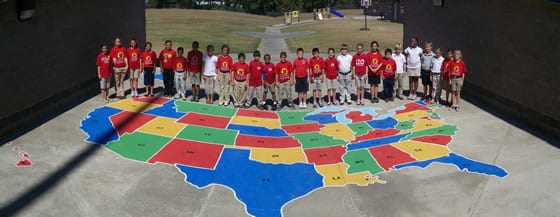
My article was about painting a map of the United States on the ground of playgrounds across the country to help students become interested in geography and improve their learning.


 I thought this was a great article because it's something simple but could have such a great impact. I remember after I left my elementary school, they painted a map of the US on the playground. I was actually kind of upset that they decided to do it after I left because I could've had so much fun with it. Not only can teachers walk their classes outside (almost as a....field trip) but students can also be interactive with it during recess time or during out of school time with friends. Teachers could play games with the states and students could play games on their own with the map. It is an easy, simple, small way to have such a big impact on students.


"Useful Instrctional Activites for the Lesson Development Phase"


As I continued to read Chapter 7 in our text book, I became really intrigued by the useful instructional activities for the lesson development phase.
Our text book listed the following:

Field Trips
 The one thing I loved LOVED about elementary school was all the field trips I went on. I think that field trips can be extremely educational and beneficial to students. What's a better way to get a child excited for learning than taking them out of their classroom and bringing them to a new location with tons of stimulation? Nothing.  Even small field trips are beneficial to students because sometimes it's nice to just be able to get out of the typical education environment.


 Guest Speakers
Having a guest speaker is second best to having a field trip. Although students don't normally get to go anywhere, it's a change to their normal day activity. Students will be eager to see what the new person coming into their classroom has to say to them.  This can also be beneficial because sometimes the speaker has gone through something that you're teaching the students. If the students can see and hear how someone lived through a time period they're learning about, they may be more willing to pay attention or even eager to go back and talk about the subject in social studies class. 


Demonstration
Not all, but many students are visual learners. Most of the time students learn and comprehend information better when it is presented in front of them in a visually stimulating way. Demonstrations are a great way to switch things up in the classroom and keep the students engaged and entertained enough to pay attention. 


 Lecture/Teacher Presentation
Even though it may not always be the most effective way, lecturing and teacher presentations can obviously help students with learning as well. Even young elementary students should be exposed to lecture style teaching, but for shorter periods of time. 

 
Games
If used properly games can be very educational and beneficial to students' learning. Everyone loves games, everyone likes to have fun! Every student needs their lesson changed up here and there, and games are a great way to switch things up while remaining educational.

"Matching Instructional Strategies to Student Needs"


          I was reading Chapter 7 in our text book Social Studies for the Elementary and Middle Grades and I was interested in what the difference is between the teaching strategies and how they benefit students in different ways.

       Direct Instruction
In direct instruction, the control is mostly in the teacher's hand. The teacher provides directions and motivation for the students, and opportunities for the students to practice their skills in different situations. The teacher also provides continuous feedback to students when they answer questions correctly. The main way to teach direct instruction is through lecture, and closed, narrow questions. 
Direct instruction requires external motivation, which students may lack, and classroom management is also key when teaching through the direct instruction. One of the main problems with direct instruction is that it produces lower levels of learning...recalling and memorizing. This makes sense because students have difficulty focusing and comprehending all the information the teacher is saying through lecture style. It really isn't easy to sit in a seat for an extended period time and listen to a teacher talk and talk all period; your mind is bound to wander and have difficulty focusing solely on what the teacher is saying.

       Guided Discovery 
In this teaching method, the teacher creates a problem, provides materials, and determines the procedures, but leaves the students to investigate, collect & analyze data, and evaluate results towards the problem. Students are provided with materials and time and use several activities to solve the problem. The students are the ones doing most of the work, while the teacher simply provides directions and asks questions to get students started and on the right path. 
Guided discovery differs from direct instruction because more control is placed on the students. Students are doing more things on their own and it is less sitting there and listening. Students are actively participating and researching a solution to the problem. Students also get to work together more during this method than in the direct instruction. This is a good method because  students get a little bit more responsibility and are being actively engaged in the lesson. Students have more responsibility and will learn how researching and analyzing data is key to solving a problem. 

       Inquiry&Problem Solving/Decision-Making 
This method is similar to guided discovery, however even more responsibility is placed on the students because they are creating their own problem versus having the teacher provide them with the problem. Students are also in charge of finding materials and figuring out the procedures necessary to solve the problem they have created. 
This method tends to motivating because students are doing basically everything on their own. They are creating their own problem, they're researching the information, they're figuring out the steps to solving the problem, and that's exciting for a student. I know, since I'm still a student, nothing feels greater than accomplishing something on your own instead of the teacher just telling you the answer.

These three methods are similar in some ways, but vary in a bunch of different ways. To me, personally, the inquiry&problem solving/decision making method sound the best to me. I'm a doer, I learn by doing things for myself, I don't learn well from sitting in a room and listening to a teacher lecture me for forty minutes. I lose focus, I get lost in the topic, my mind wanders, but if I'm doing things for myself, if I create the problem and the steps to solve it, I'm more likely to take more away from the experience than just sitting and listening to a lecture.   

Cooperative Learning


          For our last lesson, we taught using a cooperative teaching strategy. We started off the lesson by introducing nine terms to the students. These terms were definitely easier for the students to comprehend because chances are they already knew them. The terms were advertisement, campaign, demand, supply, slogan, logo, marketing, resource, scarcity. We were able to teach students that when supply goes up, so does demand, which may also cause scarcity because the product is in such high demand and that they lack resources to fill the supply. Students really seemed to comprehend the terms because they all seemed like they have heard them before.
Since today's lesson is on cooperative learning, we want students to understand what constructive criticism is since they will be working on a project together. We reviewed the definition for the students and then provided them with four examples and nonexamples of constructive criticism. We had students use the green and red cards to show us whether they thought the it was an example or a nonexample. This went pretty quickly which left a lot of time for the last thing we wanted to students to do.
           We came up with a "secret" project for the students to do with their groups. We provided students with definitions and a type of presentation; rap, poem, poster, and collage, and the students had to create it to present in front of the class. The point was for students to work together and show how much they know from the weeks that we've been teaching. after they presented, students got back into their groups and constructively criticized how they did. They received a worksheet paper to fill out to report their constructive criticism.

          I can see that cooperative learning is very different from direct instruction and inquiry but also why it is important. Students need to learn how to cooperate and learn with each other instead of just solely learning from a teacher. We were told once in class that student retain 95% of the information presented to them when it is taught from their peers and not from the teacher. If this is really true, then more lessons should be focused around students learning and teaching each other.

Inquiry Lesson Plan


            For our second lesson we taught using an inquiry/indirect lesson plan. We began today by reminding students of where we're at in the movie making process. We told students that they had about 5 minutes to put the finishing touches on their commercials and then we'd be performing them in front of the class. Luckily everyone was prepared well and the commercials.The commercials were so cute and adorable and made me so proud that the students were able to create them on their own and perform them in front of their classmates.
           Since this lesson is through inquiry steps, we reviewed the inquiry steps and showed students how they would use the inquiry steps to connect with their movies.
We gave each group a "Forecast Form" that they were to use to predict how much money their company would make off of their movie.
The estimations the students came up with were pretty reasonable and I know that made my cooperating teachers and me very excited that students were grasping the concepts that they were learning.
           Teaching through the inquiry steps was something I was definitely not used to. To be honest, I wasn't even really sure of the inquiry steps until my previous teachers had taught the students it. I don't think I've ever been taught through an inquiry process, or if I have, I have little to no recollection of it! It was definitely a little different and challenging at a point, but I can see why it's important. When we taught through direct instruction, we were teaching the students the whole time, lecturing them almost, while they sat there and took it all in. Sitting for a forty minute period listening to someone talk is a struggle for anyone, but even more of a struggle for young students who are doing their best to focus but simply can't. With the inquiry lesson plan it worked well because students had the chance to work together and work the problem out themselves without being told how to do it. This put more of the responsibility on the student, which is necessary. Students seemed to understand what was being asked of them during the inquiry process, were able to comprehend what was being taught, and each group was able to provide us with an answer to the question.

Direct Instruction Lesson Reflection


This blog is a couple weeks late as to the actual date when we performed our lesson, but I'm going to talk as if it had just happened today, because luckily I remember it just like it was yesterday!!

          Today was our first lesson, we taught the students about what makes up a good commercial using direct lesson instruction plan. We started off the lesson by having the students watch a thirty second commercial from the movie Monster's Inc. We asked students to watch the clip and then, using the commercial for help, we wanted them to tell us what THEY think makes up a good commercial. We were looking for students to say things such as: there's a narrator, they're are pop up actions that catch your attention by surprising you, there's music, they reveal the problem of the movie but not the solution, etc. The students were able to provide us with such answers, but they missed most of the terms that we were about to teach them, so it kind of worked out well still. 
          After the students gave us about eight examples we moved on with the lesson and introduced the terms that help define what a good commercial contains.
 We explained each term to the students and provided examples to them. After we did this we told students that they were going to rewatch the commercial they just previously watched. This time we wanted students to watch it with a keener eye because they knew what they'd be looking for. Once the commercial was over, we were able to relate the terms to the commercial and have students prove comprehension when they told us how each term was used in the commercial.
          Next we introduced students to other important terms when it comes to making a movie, terms that their businesses should keep in mind when creating their movies.

We provided the students with examples of each term. It was a struggle for us to think of terms for intellectual property, because our understanding of it was a little confusing. I thought that was interesting because when I was a young, naive, student I thought teachers knew everything and that they didn't really struggle with teaching us because the information was so easy to them, but this helped bring me back to reality. It's difficult teaching some subjects, because although we've learned it all before, we may not have had the best teacher teaching it or we may have not comprehended it as well as we should've. Luckily, Dr. Smirnova even helped us come up with an example for the students to understand it.
          Not going to lie, we kind of went through the terms very quickly because we needed to get onto the next part of our lesson; students creating their OWN movie commercials!! We explained to students that they'd be creating their own commercials today and that they had to include the following in their commercials.


 Students then broke off into their groups and worked on their commercials. We ended the lesson by informing students that in the next class they would be performing their commercials in front of the class! I'm excited to see how their commercials turn out because it seems that majority of students in the class, with an exception to a few, are really enjoying this project so far.